There is an old Italain saying: "Chi chiama Mamma, non s'inganna."
If you do not find your Mamma, please contact me. I may not have a good photo. You can help me with that.
Sunday, May 13, 2012
Saturday, May 12, 2012
Wednesday, May 9, 2012
Family Names
I have recently seen some searches arriving at this blog questioning the origins of the names of the families involved in it. I have done much research into all of their names, but I still have to say that in some cases..I DON'T BELIEVE A WORD OF IT...and in others, I am marginally convinced. The real problem is that there is not much written in English about these names. The Italian writings are limited as well, but anything really in depth is just too much for me in my present state of learning of Italian. Records that predate modern systems are in the archives of the archivescovo(the archbishopric). I have not had access to them and I doubt that the Mormons have them! What access to records I do have are VERY difficult to read, and they vary in format so that meaning is a bit difficult as well.
I can try to give you some cues for further research, but I am in many cases probably going to spend the rest of my life searching for the answers myself. You must also understand that I am standing on the legs of scholars when I write these things. I am finding the research of others on line or in print, and reporting my findings only.
Much of what I will tell you here comes from published sources that have long disappeared from my memory, but if you want to contact me, I can try to find them if you want to do more research.
I have arrived at no final conclusions at all about these names.
These are the names of families presently recorded in Salina I do not have similar lists for the other islands as they are not published:
Cincotta (chin-cot-ta)
I have seen two forms of the name: Cincotta and Cincotto. More recently I have seen old documents with Cingotta. When you hear the name, that central "c" can sound quite guttural, so the "g" might just be a spelling error by a person with poor hearing. It was definitely the same name though. My sources say that Cincotto comes from the far north of Italy, and is very rare. It was probably from the area in and around Venice. There were very early migrations of families to the south along with the Holy Roman Emperor(Germans) to the south, including Sicily. It probably came from a nickname that developed in a time when formal last names were pretty erratic if they existed at all outside aristocratic families. The feeling is that it developed in the family of the fifth son of his father. O and I are usually masculine endings for a word, singular and plural. A and E would be the same for female endings. So if that is true, could Cincotta be the fifth daughter of a family?
In the book Sicilian Sisters by Marianna, the author would like us to think that there were five pirate brothers who came to the islands, married five sisters and distributed themselves throughout the Aeolian Islands to escape the retribution of their past victims. Well, I definitely believe the Pirate part! Does the author believe this; is it a family story, or is it a good plot for her purposes?
Actually, the remote islands of the Mediterranean had many pirate cells. In some times there was no way to make a living other than piracy. I think, however, that for the most part, our people were more likely to be the victims of piracy, rather than pirates themselves. I suppose we have to keep an open mind however. Also in the book, the brothers were Spanish in origin. Why not?
There is a tradition that says that the name refers to the number 58. That would be "cinquantotto" in Italian and "cinquenta y ocho" in Spanish. A band of 58 pirates perhaps? Or perhaps the fifty eighth son...Tired that woman out! Now I am being silly...sorry about that.
When I do searches in Italian, I find that references(which incidentally, usually lead nowhere) say that the name originates and is concentrated in the Messina area, including the islands, and in Ustica. Ustica is an island to the north west of Sicily, where a number of Aeolian people went for land and trading opportunities. Lonely and isolated, I would not have done that myself. However we do have many distant relatives there.
Cincotta predates the perceived general arrival of the Spanish in the islands. Feudal society was pretty hands off for the most part. As it was in England, there were a handful of Barons who occupied and defended large tracts of land, and a handful of petty officials who were akin to the Sheriff of Nottingham, controlling a local area that could be covered in a day's ride. There was little interaction as they did not speak the same language, but there was sometimes a...forced...relationship between a peasant girl and an invading official.
That does not mean that individual family groups could not have arrived there as it suggests in Marianna's book. Notice the presence of the name in the list of arrivals in my later post though. Spanish were in Sicily from the very early 1400s(Aragonese), and again from the early 1500s(Spanish). These were the years in which there were Spanish(and Aragonese) Viceroys of Sicily. There was much struggle over ownership of the area between the French and the Spanish. So, since we do not have arrival dates for the Spanish names in our records, it is still an open question if this is a Spanish arrival name or not.(I do not think it is.) The Cincottas were first noticed in the records in the years following the pirate siege of the islands in 1544. The general thought is that the repopulating people were from Calabria for the most part, but some of the people who were taken from the islands by the pirates were ransomed in Messina and returned to the islands. I am not aware of a list of family names from before the pirates or a list of the families who returned to their own lands after the raid.
Reaching far back into history we have another possibility which is admittedly rather remote. In the Punic wars, there was a port at Lipari, which was the best possible in the islands as it is today. There were struggles between the Romans and the Carthaginians in and around the Aeolian Islands. The commander of roman forces there was a certain General Cotta...something to think about. I have read his name in both Suetonius' The Twelve Ceasars, and I think in Tacitus' Annals of Rome.
The name may also refer to a personal name such as Cingo or Gingo.
Cafarella
Here is another mess, though with very different issues.
The standard origin of the name says that it is derived from the word Kaafir in Arabic. This is an Arabic/local dialect name meaning the unbeliever. Infidels! Well, does this surprise anyone?
There are a number of variations, but all are listed together in the sources I have, suggesting that they are considered to be the same or related name. Cafarella(my own family and my favorite for some reason), Caffarella, Caffarela, Caferella, Cafferella, Cafarelli, Caffarelli, Cafar, Cafa, Caffa, Cafarensis(Hmmm) and Cafarellius. Cafaru is a Sicilian name which originally meant "Rotten". Like most names other than Wheeler, Smith, and similar professional or place related names, there was no such thing as a last name till relatively recently, and on top of that, there was no standardized spelling of virtually anything. Add dialects that changed with every fifty miles or less in Italy,(Italy only became a country in the 1860s and 70s after all.) and the mess is complete.
It seems that Cafar was the original name. The others may have developed from this Campagna region name. There are a number of Cafarelli references. The Cafarelli probably came to us from the Latin version of the name which can bee seen in Rome on the portal that leads from the Piazza Campodoglio designed by Michelangelo to the side of the palace that bears the Cafarelli name behind and attached to the museum facing the Piazza. There are several references to the name in palazzi in Rome. Palazzo Caffarelli Negroni being one.
The Cafarelli that is related to this site was French in origin and France has a number of Cafarelli families. A general Cafarelli was involved with Napoleon's Egyptian campaign and probably others as well. However, if we are to believe the stated origin of the name, there is no similar root in French. I do not have any second thoughts when I say that this family is of Italian origin. There is a Palace in Avignon which bears the name, on the square that also fronts the Pope's palace. They would have relocated there from Italy during the "So-called Babylonian Captivity" when the popes resided in Avignon. There was a Scipione Cafarelli who became the adopted child of the Borghese family, and began the famous sculpture collection of that family while he was a Cardinal. He was also related to one of the Popes of that time. I guess when the family business moved to France, it was a good idea to go with it.
At present I am going to have to pursue a name that might be part of our family on the mainland. The name is Don Bernardo de Natale di Cafarella in Caserta. If you do not know the area, it is north north west of Naples. Do not hold your breath! There are curious connections that I do not say are concrete in any way, but may have to pursue.
1. The Pignatelli were Spanish/Italain Viceroys of Sicily.
2. The Pignatelli and Cafarelli had adjoining estates on the Via Appia Antica in Rome.
3. The Pignatelli had some relationship to the barons near Casapulla, Caserta in Campagna.
4. The Sifolas and Natales had land granted by or somehow related to these barons and Pignatellis in Campagna.
5. Girolama Sifola married Don Bernardo Natale di Cafarella holding lands of all these people.
The final word is that there are a number of possible origins for the name. There are some expert writings that credit the name as having cropped up in different areas of the country from different roots(that is all the written variations mentioned above) Bari, Salerno, Palermo, Messina, Rieti, Torino, northern Campagna all have possible claim to the name. I will have to make a connection from the Cafarella names listed in the 1500s to their mainland origins, and then we may be able to pin it down a bit better. Give me more time and we may have an answer. However, Cafarella was always the name in the Aeolian Islands.
Vasquez
This is typically Spanish and is a very common name all over the world where there are Spanish populations. I usually hear it pronounced: "Vaskez" in Spanish populations, but my family and others I have known from the islands pronounce it: "Vascooez". It may be a derivative of the Spanish name Vasco which refers to Basque, or to the Gascony region of France. There are a number of populations in Italy and it would be likely to appear anywhere that the Spanish settled and in the kingdoms taken over by the Spanish.(The southern half of the mainland of Italy and all of Sicily and it's islands.) There are supposedly large populations in Syracusa, Noto and other areas of Sicily, but also in Bari and Naples.
The article I placed elsewhere in the blog noted that it arrived in the islands in the period after the depopulation in the 1500s, usually as administrators. The Spanish actually arrived to take over Southern Italy and Sicily in the last decade of the 1400s, though when they arrived in the islands could be somewhat later. It seems to me that they probably were there before the depopulation as it usually took no time at all for a new king or administrator to lay claim to an area.
The name refers to the spanish for Crow. This is rather odd as on my English side our earliest known name is Corbet or Le Corbeau referring to a raven.
Megna
The Megna name, if it is the same as that found all over Italy, comes from the name Omegna which originated in the Piedmont area called Novara Province and refers to a town of that name at the northernmost point in Lago Orta. The name has a number of population concentrations in Italy.
One area where it is common is in neighboring Lombardy. It also occurs in some concentrations in Sicily, especially Palermo, Calabria and Campagna. These statistics of areas of concentration are based on current populations. Since it is not unusual for many people to migrate to the jobs, we might concentrate on those areas where they might have come FROM, rather than the large job markets where people WENT. Calabria was likely to be the area that most recently fed the islands, though they may have originated there in Piedmont.
As the name appears after the depopulation of 1544, I would assume that the source of the name would be confirmed as Calabria, at least most recently.
The name entered our Cincotta family in the 1840s.
Lazzaro
This too is a pretty obvious derivation. The name is a form of Lazarus. It refers to Aramaic: La'zar for "aid of God". Strangely we have a Lazar in the family, as well as Lazzaro a few generations back. This name probably arrived in Sicily and the islands during early periods when there were many Jewish families. They were so common, that it would be difficult I would think, not to find some trace of jewish roots in all families of the south. The published sources have this name originating in Lombardy with branches in Brescia, Milan and Bergamo in the far north. They also state that the name is dotted around the Italian penninsula like leopard spots! Of course, the lazarus in the bible is revered in Christian communities as well as Jewish. I suppose the source of our Lazzaro names could be from either source. There are several Lazarus' that could be a source of this Sirname. Lazarus of Bethany(Raised from the dead. Lazarus of Persia(a martyr), Lazarus and the rich man from the new testament and Lazarus, Bishop of Milan in the 400s.
Personally I think that the Jewish presence in Sicily is our most likely source for the name, but again, migrations from the north were pretty common, especially when the German and northen Italian Holy Roman Empire was supplying rulers in Sicily. You may have noted that the name was listed in the arrivals post 1544.
The name has some unsavoury connotations as well. It can mean a person who may only have been born with the help of god. It can refer to people with skin diseases, rashes, leprosy etc., and sometimes as a scoundrel or malefactor of some kind. That being said, there is no shortage of great people in the North, and there is a famous Lazzari family involved in politics around the time of an arrival of nobles in Sicily in 1584. This could account for the name's arrival as the arrival dates post mentions their arrival after 1544.
Sangiolo
Sangiolo is a name which has defied every attempt I have made to define it. Following the spelling variations that are common in the family, there is no Sangiolo or Sanciolo recorded anywhere, but Sangio and Sancio do exist in the general Sicily, Calabria, Puglia area. Following those names and their close realtions we have various forms of Sanchez, and a number of shorter forms of Sangiolo or Sanciolo, like: Sanci, Sancio, Sanciu, Sangi, Sangio. Proving that these are connected will mean tracing the family back till the original name finally appears, but to me, this is a logical connection. These names appear all over Italy, many of them in Sicily and Calabria, as well as in the far north. If indeed connected, some form of the Sangiolo name may go back to Roman times. I am having enough trouble following the Cafarellas and Cincottas, so the likelihood that I can trace the Sangiolos is pretty slim. Those with the name should be searching for someone to start this research.
The name does not appear in the roster of names arriving in the islands posted elsewhere in the site. One can never trust records completely, but it seems likely that the name is a recent arrival in the islands. I have records that put the name into the middle of the 19th century with Luigi Sangiolo in Capofaro. We are used to seeing women being brought in from the mainland or Sicily, but there is no reason that Luigi or his father or grandfather could not have married an island girl and stayed.
Marchetti
Marchetti is like a number of related names derived from the latin name Marcus or the medieval Marchettus. Marchetti specifically is all over the north central areas of Italy and also in Apulia.
It is not a terribly common name in the south, though it is not unusual in Naples and farther north. There are some examples scattered in Calabria and all over Sicily however.
Marcetta is present in the islands after the depopulation in 1544, and could be a variation in spelling of Marchetti, and except for a few branches coming from Rome, the origins would not be much different from the Marchetti name. If this is not the family, then it must be a more recent arrival in the islands. Here is another example of someone needing to follow the name back to its point of origin on the mainland or Sicily, or to find the connection with the name Marcetta if there is one.
There are also Marchetta families in the islands which may be from the same source, being only a spelling variation, or could have come from another population on the mainland or Sicily.
I can try to give you some cues for further research, but I am in many cases probably going to spend the rest of my life searching for the answers myself. You must also understand that I am standing on the legs of scholars when I write these things. I am finding the research of others on line or in print, and reporting my findings only.
Much of what I will tell you here comes from published sources that have long disappeared from my memory, but if you want to contact me, I can try to find them if you want to do more research.
I have arrived at no final conclusions at all about these names.
These are the names of families presently recorded in Salina I do not have similar lists for the other islands as they are not published:
ALAIMO, ALIZZI, ALIZZO, ANDREUCCI, AQUILA, ARDITA,
ARGENTARO, BALDANZA, BARBAGALLO, BARBERA, BARBUTO, BASILE, BELFIORE,
BELLACHIOMA, BENENATI, BEVACQUA, BIVIANO, BONGIORNO, BRUNDU, BUTTO' , CACCETTA, CAFARELLA, CAMPO, CANGEMI, CAPELLO, CAPEZZA, CAPUTO,
CARRA, CARRA', CASALE, CASTELLITTO, CATANIA, CATANZARO, CELI, CERAOLO, CEREGHINI, CIAMPI, CICCOLO, CINCOTTA, COLONNA, CONTI, COSTANTINO,
CRISA', CUTRONI, D'ALIA PERZITA, D'IPPOLITO, DAVINI, DE LORENZO, DE
MARIA, DI CARO, DI GIORGIO, DI LOSA, DI MAIO, FAMULARO, FARCHI,
FENECH, FERRERO, SIRAGUSANO, FIORDALISI, GALLETTA, GALLUZZO, GANGEMI,
GARITO, GENOVESE, GIANI, GIARDINA, GIARDINELLO, GIOVENCO, GOVERNALE,
GRENCI, GRILLI, GUIDELLI GUIDI, GULLO, IOPPOLO, ISAJA NUNNARI, LA CORTE,
LA GINESTRA, LA MANCUSA, LA ROSA, LANDUZZI, LENZO, LEONARDI, LO MONACO, LO SCHIAVO, LOCANTRO, LONGHITANO, LONGO, LOPES, MANNUCCIA, MARATONA, MARCHETTA, MARCHETTI, MARINO, MECCIO, MERENDA, MERLINO, MESSINA, MICELI, MINISTERI, MIRODDI, MONTELEONE, MORELLO GARITO, OFRIA, PAINO,
PALERMO, PALMIERI, PALMISANO, PANTO', PARATORE, PAVONE, PICONE PALERMO, PIRERA, PODETTI, PORCINO, PRIVITERA, QUATTROCCHI, RANDAZZO,
RANDO, RAVESI, RESTUCCIA, RISTUCCIA, ROFFARE', ROLLIER-STEINER,
RUSSO, SALTALAMACCHIA, SANGIOLO, SANTACROCE, SANTOSPIRITO, SANTOVETTI , SAPORITO, SCAFIDI, SCIACCHETANO, SCIARRONE, SEGRETO, SGRO', SIRACUSANO, SONEGO, SOTTILE, SPANO', TARANTO, TERRANOVA, TORRETTA, TRAVAGLIA, TRIOLO, VANELLI, VASQUEZ, VIOLETTI, VIRGONA, ZAFFIMO,
ZAFFINO, ZAGAMI.
Cincotta (chin-cot-ta)
I have seen two forms of the name: Cincotta and Cincotto. More recently I have seen old documents with Cingotta. When you hear the name, that central "c" can sound quite guttural, so the "g" might just be a spelling error by a person with poor hearing. It was definitely the same name though. My sources say that Cincotto comes from the far north of Italy, and is very rare. It was probably from the area in and around Venice. There were very early migrations of families to the south along with the Holy Roman Emperor(Germans) to the south, including Sicily. It probably came from a nickname that developed in a time when formal last names were pretty erratic if they existed at all outside aristocratic families. The feeling is that it developed in the family of the fifth son of his father. O and I are usually masculine endings for a word, singular and plural. A and E would be the same for female endings. So if that is true, could Cincotta be the fifth daughter of a family?
In the book Sicilian Sisters by Marianna, the author would like us to think that there were five pirate brothers who came to the islands, married five sisters and distributed themselves throughout the Aeolian Islands to escape the retribution of their past victims. Well, I definitely believe the Pirate part! Does the author believe this; is it a family story, or is it a good plot for her purposes?
Actually, the remote islands of the Mediterranean had many pirate cells. In some times there was no way to make a living other than piracy. I think, however, that for the most part, our people were more likely to be the victims of piracy, rather than pirates themselves. I suppose we have to keep an open mind however. Also in the book, the brothers were Spanish in origin. Why not?
There is a tradition that says that the name refers to the number 58. That would be "cinquantotto" in Italian and "cinquenta y ocho" in Spanish. A band of 58 pirates perhaps? Or perhaps the fifty eighth son...Tired that woman out! Now I am being silly...sorry about that.
When I do searches in Italian, I find that references(which incidentally, usually lead nowhere) say that the name originates and is concentrated in the Messina area, including the islands, and in Ustica. Ustica is an island to the north west of Sicily, where a number of Aeolian people went for land and trading opportunities. Lonely and isolated, I would not have done that myself. However we do have many distant relatives there.
Cincotta predates the perceived general arrival of the Spanish in the islands. Feudal society was pretty hands off for the most part. As it was in England, there were a handful of Barons who occupied and defended large tracts of land, and a handful of petty officials who were akin to the Sheriff of Nottingham, controlling a local area that could be covered in a day's ride. There was little interaction as they did not speak the same language, but there was sometimes a...forced...relationship between a peasant girl and an invading official.
That does not mean that individual family groups could not have arrived there as it suggests in Marianna's book. Notice the presence of the name in the list of arrivals in my later post though. Spanish were in Sicily from the very early 1400s(Aragonese), and again from the early 1500s(Spanish). These were the years in which there were Spanish(and Aragonese) Viceroys of Sicily. There was much struggle over ownership of the area between the French and the Spanish. So, since we do not have arrival dates for the Spanish names in our records, it is still an open question if this is a Spanish arrival name or not.(I do not think it is.) The Cincottas were first noticed in the records in the years following the pirate siege of the islands in 1544. The general thought is that the repopulating people were from Calabria for the most part, but some of the people who were taken from the islands by the pirates were ransomed in Messina and returned to the islands. I am not aware of a list of family names from before the pirates or a list of the families who returned to their own lands after the raid.
Reaching far back into history we have another possibility which is admittedly rather remote. In the Punic wars, there was a port at Lipari, which was the best possible in the islands as it is today. There were struggles between the Romans and the Carthaginians in and around the Aeolian Islands. The commander of roman forces there was a certain General Cotta...something to think about. I have read his name in both Suetonius' The Twelve Ceasars, and I think in Tacitus' Annals of Rome.
The name may also refer to a personal name such as Cingo or Gingo.
Cafarella
Here is another mess, though with very different issues.
The standard origin of the name says that it is derived from the word Kaafir in Arabic. This is an Arabic/local dialect name meaning the unbeliever. Infidels! Well, does this surprise anyone?
There are a number of variations, but all are listed together in the sources I have, suggesting that they are considered to be the same or related name. Cafarella(my own family and my favorite for some reason), Caffarella, Caffarela, Caferella, Cafferella, Cafarelli, Caffarelli, Cafar, Cafa, Caffa, Cafarensis(Hmmm) and Cafarellius. Cafaru is a Sicilian name which originally meant "Rotten". Like most names other than Wheeler, Smith, and similar professional or place related names, there was no such thing as a last name till relatively recently, and on top of that, there was no standardized spelling of virtually anything. Add dialects that changed with every fifty miles or less in Italy,(Italy only became a country in the 1860s and 70s after all.) and the mess is complete.
It seems that Cafar was the original name. The others may have developed from this Campagna region name. There are a number of Cafarelli references. The Cafarelli probably came to us from the Latin version of the name which can bee seen in Rome on the portal that leads from the Piazza Campodoglio designed by Michelangelo to the side of the palace that bears the Cafarelli name behind and attached to the museum facing the Piazza. There are several references to the name in palazzi in Rome. Palazzo Caffarelli Negroni being one.
The Cafarelli that is related to this site was French in origin and France has a number of Cafarelli families. A general Cafarelli was involved with Napoleon's Egyptian campaign and probably others as well. However, if we are to believe the stated origin of the name, there is no similar root in French. I do not have any second thoughts when I say that this family is of Italian origin. There is a Palace in Avignon which bears the name, on the square that also fronts the Pope's palace. They would have relocated there from Italy during the "So-called Babylonian Captivity" when the popes resided in Avignon. There was a Scipione Cafarelli who became the adopted child of the Borghese family, and began the famous sculpture collection of that family while he was a Cardinal. He was also related to one of the Popes of that time. I guess when the family business moved to France, it was a good idea to go with it.
At present I am going to have to pursue a name that might be part of our family on the mainland. The name is Don Bernardo de Natale di Cafarella in Caserta. If you do not know the area, it is north north west of Naples. Do not hold your breath! There are curious connections that I do not say are concrete in any way, but may have to pursue.
1. The Pignatelli were Spanish/Italain Viceroys of Sicily.
2. The Pignatelli and Cafarelli had adjoining estates on the Via Appia Antica in Rome.
3. The Pignatelli had some relationship to the barons near Casapulla, Caserta in Campagna.
4. The Sifolas and Natales had land granted by or somehow related to these barons and Pignatellis in Campagna.
5. Girolama Sifola married Don Bernardo Natale di Cafarella holding lands of all these people.
The final word is that there are a number of possible origins for the name. There are some expert writings that credit the name as having cropped up in different areas of the country from different roots(that is all the written variations mentioned above) Bari, Salerno, Palermo, Messina, Rieti, Torino, northern Campagna all have possible claim to the name. I will have to make a connection from the Cafarella names listed in the 1500s to their mainland origins, and then we may be able to pin it down a bit better. Give me more time and we may have an answer. However, Cafarella was always the name in the Aeolian Islands.
Vasquez
This is typically Spanish and is a very common name all over the world where there are Spanish populations. I usually hear it pronounced: "Vaskez" in Spanish populations, but my family and others I have known from the islands pronounce it: "Vascooez". It may be a derivative of the Spanish name Vasco which refers to Basque, or to the Gascony region of France. There are a number of populations in Italy and it would be likely to appear anywhere that the Spanish settled and in the kingdoms taken over by the Spanish.(The southern half of the mainland of Italy and all of Sicily and it's islands.) There are supposedly large populations in Syracusa, Noto and other areas of Sicily, but also in Bari and Naples.
The article I placed elsewhere in the blog noted that it arrived in the islands in the period after the depopulation in the 1500s, usually as administrators. The Spanish actually arrived to take over Southern Italy and Sicily in the last decade of the 1400s, though when they arrived in the islands could be somewhat later. It seems to me that they probably were there before the depopulation as it usually took no time at all for a new king or administrator to lay claim to an area.
The name refers to the spanish for Crow. This is rather odd as on my English side our earliest known name is Corbet or Le Corbeau referring to a raven.
Megna
The Megna name, if it is the same as that found all over Italy, comes from the name Omegna which originated in the Piedmont area called Novara Province and refers to a town of that name at the northernmost point in Lago Orta. The name has a number of population concentrations in Italy.
One area where it is common is in neighboring Lombardy. It also occurs in some concentrations in Sicily, especially Palermo, Calabria and Campagna. These statistics of areas of concentration are based on current populations. Since it is not unusual for many people to migrate to the jobs, we might concentrate on those areas where they might have come FROM, rather than the large job markets where people WENT. Calabria was likely to be the area that most recently fed the islands, though they may have originated there in Piedmont.
As the name appears after the depopulation of 1544, I would assume that the source of the name would be confirmed as Calabria, at least most recently.
The name entered our Cincotta family in the 1840s.
Lazzaro
This too is a pretty obvious derivation. The name is a form of Lazarus. It refers to Aramaic: La'zar for "aid of God". Strangely we have a Lazar in the family, as well as Lazzaro a few generations back. This name probably arrived in Sicily and the islands during early periods when there were many Jewish families. They were so common, that it would be difficult I would think, not to find some trace of jewish roots in all families of the south. The published sources have this name originating in Lombardy with branches in Brescia, Milan and Bergamo in the far north. They also state that the name is dotted around the Italian penninsula like leopard spots! Of course, the lazarus in the bible is revered in Christian communities as well as Jewish. I suppose the source of our Lazzaro names could be from either source. There are several Lazarus' that could be a source of this Sirname. Lazarus of Bethany(Raised from the dead. Lazarus of Persia(a martyr), Lazarus and the rich man from the new testament and Lazarus, Bishop of Milan in the 400s.
Personally I think that the Jewish presence in Sicily is our most likely source for the name, but again, migrations from the north were pretty common, especially when the German and northen Italian Holy Roman Empire was supplying rulers in Sicily. You may have noted that the name was listed in the arrivals post 1544.
The name has some unsavoury connotations as well. It can mean a person who may only have been born with the help of god. It can refer to people with skin diseases, rashes, leprosy etc., and sometimes as a scoundrel or malefactor of some kind. That being said, there is no shortage of great people in the North, and there is a famous Lazzari family involved in politics around the time of an arrival of nobles in Sicily in 1584. This could account for the name's arrival as the arrival dates post mentions their arrival after 1544.
Sangiolo
Sangiolo is a name which has defied every attempt I have made to define it. Following the spelling variations that are common in the family, there is no Sangiolo or Sanciolo recorded anywhere, but Sangio and Sancio do exist in the general Sicily, Calabria, Puglia area. Following those names and their close realtions we have various forms of Sanchez, and a number of shorter forms of Sangiolo or Sanciolo, like: Sanci, Sancio, Sanciu, Sangi, Sangio. Proving that these are connected will mean tracing the family back till the original name finally appears, but to me, this is a logical connection. These names appear all over Italy, many of them in Sicily and Calabria, as well as in the far north. If indeed connected, some form of the Sangiolo name may go back to Roman times. I am having enough trouble following the Cafarellas and Cincottas, so the likelihood that I can trace the Sangiolos is pretty slim. Those with the name should be searching for someone to start this research.
The name does not appear in the roster of names arriving in the islands posted elsewhere in the site. One can never trust records completely, but it seems likely that the name is a recent arrival in the islands. I have records that put the name into the middle of the 19th century with Luigi Sangiolo in Capofaro. We are used to seeing women being brought in from the mainland or Sicily, but there is no reason that Luigi or his father or grandfather could not have married an island girl and stayed.
Marchetti
Marchetti is like a number of related names derived from the latin name Marcus or the medieval Marchettus. Marchetti specifically is all over the north central areas of Italy and also in Apulia.
It is not a terribly common name in the south, though it is not unusual in Naples and farther north. There are some examples scattered in Calabria and all over Sicily however.
Marcetta is present in the islands after the depopulation in 1544, and could be a variation in spelling of Marchetti, and except for a few branches coming from Rome, the origins would not be much different from the Marchetti name. If this is not the family, then it must be a more recent arrival in the islands. Here is another example of someone needing to follow the name back to its point of origin on the mainland or Sicily, or to find the connection with the name Marcetta if there is one.
There are also Marchetta families in the islands which may be from the same source, being only a spelling variation, or could have come from another population on the mainland or Sicily.
Saturday, February 11, 2012
What was that name again?


Photos:
1. Taking the Statue of Saint Joseph down from his niche in San Lorenzo for the feast of Saint Joseph in Malfa.
2. The end of the procession as it arrives at San Lorenzo for the feast of San Giuseppe. The church was rebuilt after the earthquake of 1926 and finished in 1933.
3. The banquet and beggars at the feast of Saint Joseph in Malfa.
4. The Cathedral of San Bartolomeo in Lipari.
5. Statue in silver of Saint Bartholomew in the Norman and much refurbished cathedral of San Bartolomeo in Lipari.
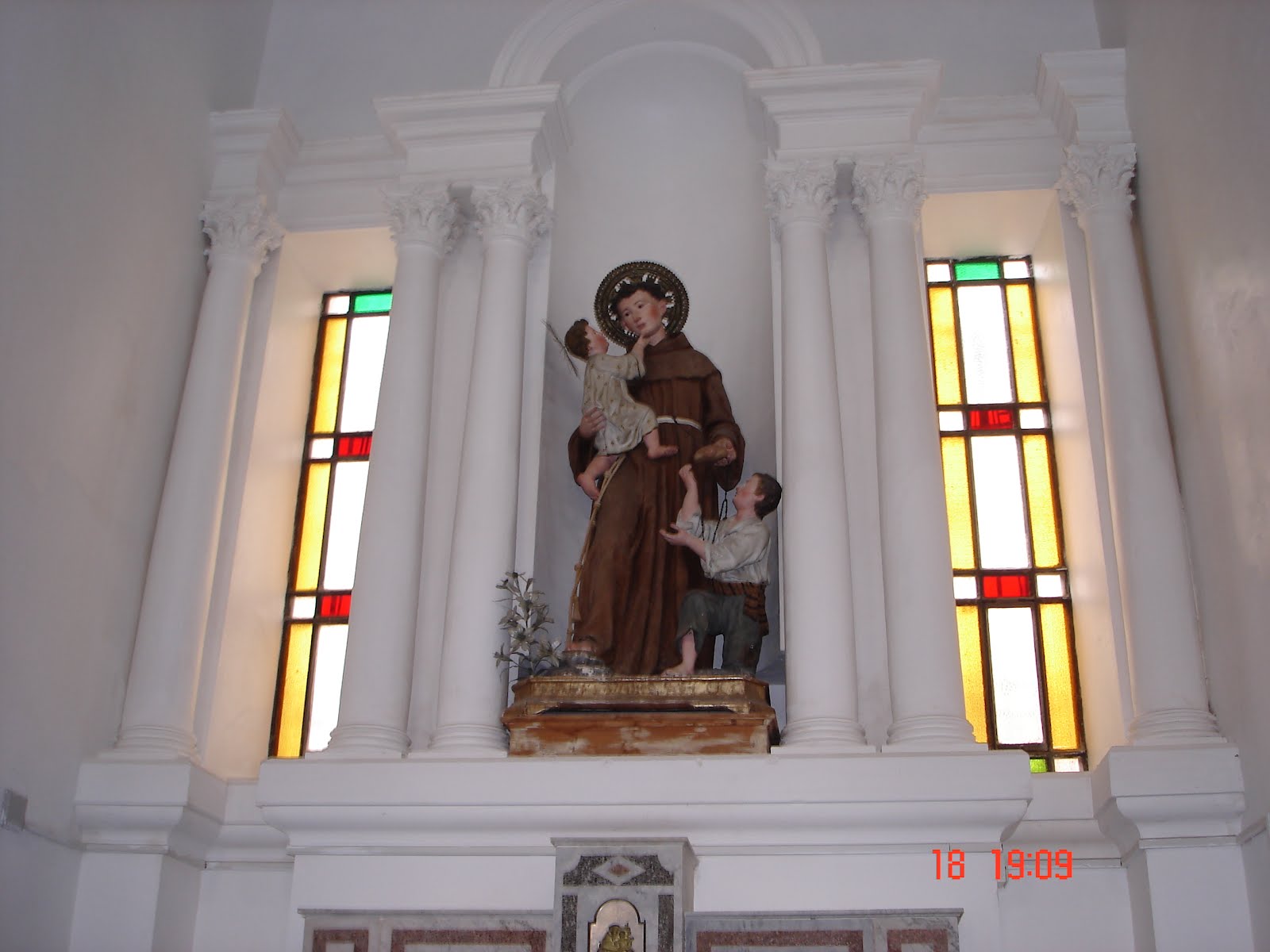
6. Statue of Saint Anthony of Padua in the church of San Lorenzo in Malfa.
Philip Anerio
Saint Philip Neri born in Florence, He spent much of his life in Rome, but passed his apprenticeship years in Campagna in the town of San Germano at the base of the hill where Monte Cassino monastery is located. It was there that his calling was revealed to him.
"A joyful heart is more easily made perfect than a downcast one."
Saint Philip Romolo Neri (Italian: Filippo Neri) (7/21/1515 – 5/25/1595), also known as Apostle of Rome, was an Italian priest, founded a society of secular priests called the "Congregation of the Oratory".
It also may refer to the Reverend Mr. Giovanni Francesco Anerio(A lay member of the Oratorio is not necessarily ordained?) composer of sacred music. His family was devoted to St Philip, and he was closely associated with St Philip's Oratorio in Rome.
St. Philip's feast day is May 26.
Onofrio
This refers to Saint Onofrio.
Sicilians pray to Saint Onuphrius to help them find lost articles. The usual prayer mention the miraculous properties of Saint Onuphrius' hair. Supposedly if you repeat any variation of the prayer to him while looking for the article that is lost, it will help to find it faster.
Onuphrius/Onoufrios (Greek and Egyptian: Wnn-nfr meaning "he-who-is-continuously-good". He is Saint Onuphrius in both the Roman Catholic Church and Eastern Catholic Churches he is Venerable Onuphrius in the Eastern Orthodox Church and Saint Nofer the Anchorite in Oriental Orthodoxy. He was a hermit in the desert of Upper Egypt in the 4th or 5th centuries.
He became one of the patron saints of Palermo in 1650. there is a church dedicated to him in Pollara. Particular interest in him may have been imported from Calabria.
One of the stories associated with him has a strange gender switch. Onofrio was born a girl according to this tradition, and wanting to preserve her virginity in her life devoted to god, she prayed to become a man, and this was granted to her.
Onofrio was very like any number of hermits who lived in the desert at this time, but the story of his/her gender switch and the fact that he was supposedly visited only by the holy spirit who delivered the host to him each week in the desert, singled him out. Also an account by a cleric who visited him on the day of his death was much publicised. He was said to be dressed only in his miraculously long hair and a loincloth of leaves...where he got the leaves in the desert is up to you to decide.
Also Humphrey and a number of other variations of the name exist.
See also Piazza Ugo San Onofrio in Lipari. His feast day is June 12.
Giuseppe/Giuseppa/Giuseppina
When you know that this translates to Joseph, I think that all is obvious. This name honors Saint Joseph. The feast day of Saint Joseph is celebrated everywhere in the islands and indeed all of Sicily with special cakes and pastries and a chick pea and pasta soup. His feast day is celebrated on March 19th in Malfa and on the third Sunday of the month in Lingua. Another is celebrated in Leni on the 1st of May.
A large banquet is laid out in front of the church in Malfa after two huge pots are carried up from the main street of town. They are filled with soup cooked on an open fire, then poles are slipped through the handles of the pots to be carried by two men. There is a large cake and most of the local people will carry platters of their home made specialties in the procession to the church of San Lorenzo at the top of the town.
Once the banquet is laid out, the mock holy family who led the procession is seated at the table while everyone else is separated from the table by barriers. The townspeople beg at the barrier for food, and are given small portions by people serving from within. The soup is served to all who crowd around the pots, and a demi-john of red wine is set out between the staircases of the church.
Gaetano/Gaetana
Thomas and also St. Cajetan, is usually used as a translation for this name. His feast is celebrated on Lipari and at Rinella on the 6th,7th(his feast day) and 8th of August. There is a fish festival coinciding with it in Lipari and a procession of boats off Rinella. Though from Vicenza, he spent much of his life in Rome where he was an intimate of the popes there, and escaped to Venice when the city was sacked in 1527. He founded hospitals and the Oratory of Love. He founded a house of the Theatine order in Naples in 1533 where he spent the rest of his life. As with many saints of this time period, he is credited with the check of Lutheranism, this time in Naples.
Lorenzo/Lorenza
This name honors Saint Lorenzo or Lawrence of Rome. The church at the top of the town in Malfa is San Lorenzo.
Saint Lawrence or Laurentius 225-258 AD was one of the seven Deacons of Rome. He was ordered by the Romans to give up the riches of the church. He quickly distributed all the wealth of the church to the poor of the city, and when the payment was demanded, he presented the Romans with the poor and downtrodden of the city as the true riches of the church. There are similar stories associated with other early Christians. He was said to be martyred as a result of this defiance. Tradition says that he was seared on a gridiron. He is said to have lain on the gridiron, then saying that he was done on that side, and it was time to turn him over. Great story, but it may have arisen from the mistranslation of the words "he suffered" as "he was roasted".
His feast is celebrated on August 10th in Malfa, and is one of the most widely celebrated of all saints.
Bartolomeo or Nathaniel(in the New Testament)
Batholomew, Batolomeo,Bartolo and Bert are common variations. He was one of the twelve apostles. He was introduced to Jesus by Philip. He became a missionary as did the other apostles. some say he went to India to spread the word. Also he is supposed to have gone to Mesopotamia, Ethiopia and many other far flung places and finally to Armenia. One tradition says that he was beheaded, and another that he was flayed alive and crucified head downwards in Albanopolis in Armenia. His name means: son of the furrows in Aramaic, and may mean that he was a plowman.
His relics were said to have been washed ashore on the Island of Lipari in a lead coffin, though his resting place in 507 was Dara-Europus in Asia Minor. His body was kept in the cathedral of St Bartholomew in Lipari. By 803, he was moved to Benevento and on to Rome in 983. His arm is in Frankfurt and part of his skull is in Canterbury Cathedral.
He is honored from August 21st to 24th in Lipari, but his traditional feast day falls on the 29th. September 11th in the Coptic Orthodox Church.
He has a special association with hospitals.
Mary
We all know about Mary and I do not need to go into detail about her. On the islands, perhaps all over the country, Mary is usually paired with another name. One I find fun to say is the pairing of Mary and Joseph. This becomes Maria Giuseppa. I was told by Catherine Marchetti, also known as Catherine Santospirito in Malfa, that the double names were slurred together...perhaps in a fit of impatience most often...as MARAGIUSEP...say it fast.
Anna
Anne was the mother of Mary and was descended from the house of David. There is a church at Capo Faro dedicated to her and her feast is celebrated on July 26th. The name comes from the Hebrew Hanna which means "Grace" or "Favor". She is not very widely venerated in the west, but the eastern churches celebrate her in a number of different occasions. The term Immaculate Conception actually refers to the fact that Mary was born from Anna without the help of a man. This may seem strange as traditions say that she may have had as many as three very real husbands.
Margaret, Pelagia, Margarita, Marina.
Santa Marina or Margaret of Antioch was the daughter of a pagan priest who cast her out. She was given refuge by a shepherdess and became one herself. She was offered marriage by a local governor if she would renounce her Christianity. When she would not, she was tortured. Her feast is celebrated on July 20 in the Roman Catholic and Anglican Churches and on the 17th by Eastern churches and on Salina where the town of Santa Marina is named for her.
Anthony, Antonio, Antonia, Antonella
Saint Anthony of Padua is widely venerated, but there is also Saint Anthony the Great from whom he took his name. For us, I think we can concentrate on Anthony of Padua as he is the one seen in statues on the islands. He lived in 13th century Lisbon where he was born. He loved the Franciscan rule that was new at the time. He was then a priest but received permission to become a Franciscan monk. He wanted to go to Morocco to preach to the Muslims, but ill health turned him back for a landing in Messina. He traveled on to Padua from there. He is remembered as a great orator, and as the saint of reconciled marriages. Also, here is another saint connected with lost articles, probably the more famous. His feast day is June 13th
Giovanni/Giovanna
There are so many Johns in the roll-call of saints that it is impossible to know for sure which one a child is named for unless one knows the devotion, interests and local worship patterns for a family.
There is Saint John the Divine, Saint John the Evangelist, Saint John of Patmos, Saint John of the bull, Saint John the list of thirty others. One that is often used in naming children is John the Baptist, but don't lose your head, these children are often named Giovanni Battista.
Saint John, the one who wrote Revelations is not a special favorite of mine....too mystical for me. I really like John the Baptist, and I choose to believe he is the one that our family members are named after. There are churches dedicated to Saint John the Baptist in several places in Sicily, the Amalfi coast and in Calabria. All are places our relatives came from. Amalfi merchants are well known for their devotion to Saint John and restored the church dedicated to him in Jerusalem during the Crusades period. His feast day is June 24th.
Wednesday, January 18, 2012
Jenny and her unknown brothers.
There were a number of children born to my grandmother Cafarella that were virtually unknown to us for a number of years. Uncle Joe did not speak of them, nor did my mother or grandmother. I like to think, as the ancient Egyptians did, that if you speak someone's name, they live again. You will find the story of Jenny Cafarella elsewhere in the genealogy, so I will not go into detail here.
Recently I was doing some work on a house in Abington Ma. I had to let my generator run for a couple of hours at a time to pump out a basement.
What to do with the time....?
I drove up to the Massachusetts Archives next to the JFK library. I had tried to find her name before without much luck, but my faulty logic had placed her in a slightly different time period. This day, it took me about an hour, but there she was. So tragic a story can now start to take form.
Jenny Cafarella (Please say it aloud) was born on September 14th, 1911 on Pierce Street in Hyde Park Ma..
Some of John's records were found as well. He was born on 3-6-1917 at 314 Eastern Ave. in Malden. I assume that they made this move to get away from memories of Jennie's tragic death.
Gaetano was born on 12-15-1906 and died 1-11-1907, both at 74 Oakland Street in Malden.
The other siblings may never have been recorded, but I will continue to search and update the post.
Death records are being digitalized and are unavailable for a year and a half. I may be able to access them some other way in the future.
Roberto Cafarella, and Bartolomeo Cafarella are the brothers whose records are still to be found.
Friday, January 13, 2012
A series of beautiful photos of the island

Go to the following link for some beautiful photos of the island of Salina from all sides. It really gives you a good idea of the topography. Under view more photos at the lower right, the final photo will show you a great direct view of Malfa and Capo Faro at the left. This is especially good for memebers of my central family as that is the area where most of the immediate family is from.
http://marinas.com/view/overview/789_Isola_Salina_Northern_Sicilian_Coast_Italy
You may have to type the entire address into the address bar at the top of your page, copy and paste into any of the search bars yeilds poor results at best.
You might try the search at the top of the page for pictures of the other islands. These are for sale as downloads or prints if you want a copy. I have no affiliation to this site, I just think it is beautiful.
Tuesday, September 28, 2010
Subscribe to:
Posts (Atom)